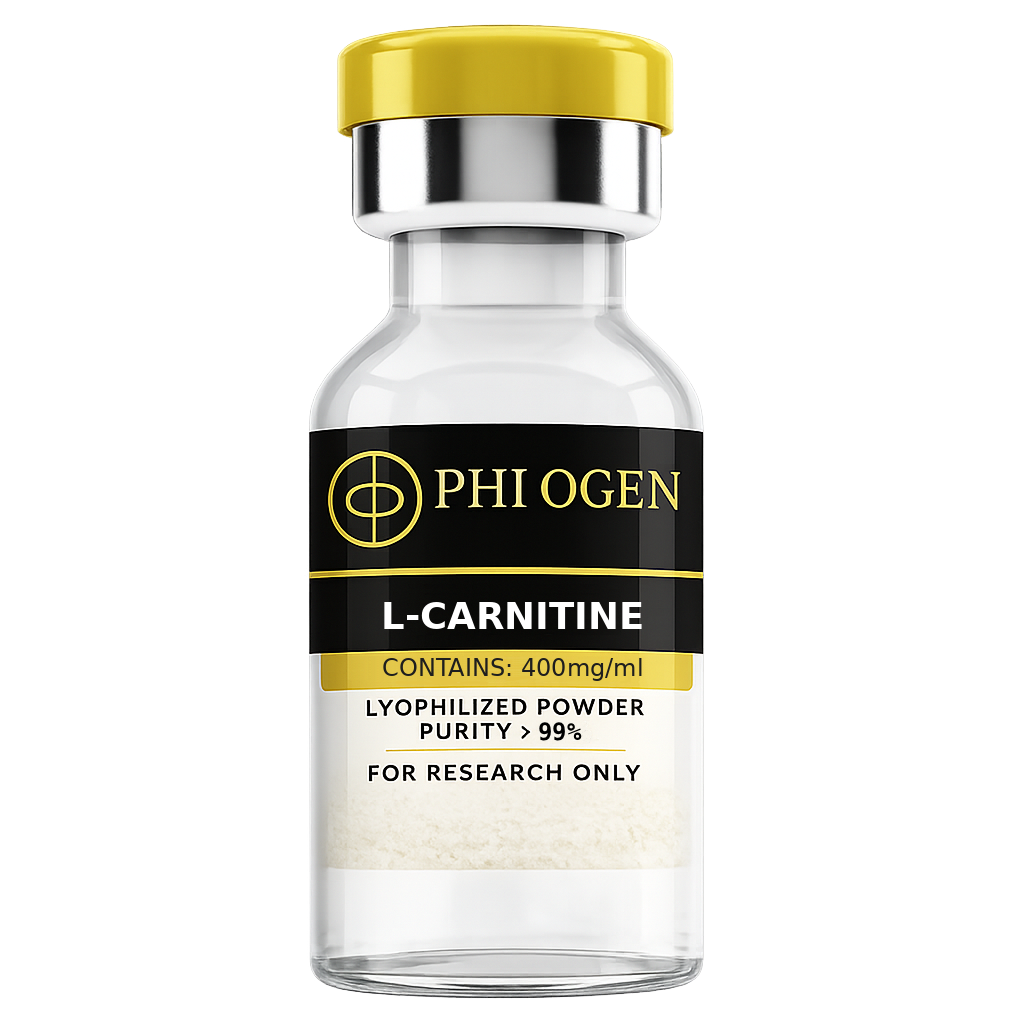
L-Carnitine 400mg/mL
Injectable L-Carnitine — mitochondrial fat transport for enhanced fat oxidation.
14.9%
Avg body weight reduction
68wk
STEP-1 trial duration
FDA
Reviewed mechanism
Buy verified L-Carnitine 400mg/mL injectable. Essential mitochondrial cofactor for fatty acid transport and fat oxidation.
Rate-Limiting Gate for Fat Burning
Long-chain fatty acids cannot enter the mitochondrial matrix without carnitine — it is the literal molecular gate that determines whether free fatty acids get burned or accumulate. Injectable carnitine opens this gate wider than any oral supplement can by delivering concentrations that drive mass-action tissue uptake.
Injectable vs. Oral: Pharmacokinetic Superiority
Oral carnitine has 14–18% bioavailability with absorption saturation limiting uptake. IV administration bypasses intestinal absorption entirely, producing plasma and muscle carnitine concentrations that oral dosing cannot achieve regardless of dose — making injectable the choice for maximum fat oxidation support.
Meta-Analytic Sports Performance Evidence
Multiple meta-analyses confirm that carnitine supplementation (particularly injectable protocols) increases muscle carnitine content, improves ventilatory threshold performance, and reduces exercise-induced muscle damage — among the most consistently replicated ergogenic effects in the sports supplementation literature.
L-Carnitine Injectable: Fat Oxidation Protocol
Mechanism · Evidence · Application
L-Carnitine is an amino acid derivative (synthesized from lysine and methionine) essential for the transport of long-chain fatty acids across the inner mitochondrial membrane — the rate-limiting step for fatty acid beta-oxidation that determines how efficiently fat is burned for energy. Without carnitine, long-chain fatty acids (>12 carbons) cannot enter the mitochondrial matrix for oxidation, regardless of how much free fatty acid is available in the cell. This makes L-carnitine bioavailability a literal gating mechanism for the primary fat-burning pathway in muscle and other tissues.
The fatty acid transport mechanism involves carnitine palmitoyltransferase I (CPT-I) on the outer mitochondrial membrane, which conjugates long-chain acyl-CoA to carnitine, and CPT-II on the inner membrane, which releases the acyl group back to CoA in the matrix. The acylcarnitine intermediate crosses the inner membrane via the carnitine-acylcarnitine translocase. This entire shuttling system depends on adequate free carnitine — and carnitine deficiency (from dietary insufficiency, renal loss, or genetic disorders) produces characteristic metabolic dysfunction: impaired fat oxidation, accumulation of long-chain acylcarnitine species, hypoglycemia during fasting, and muscle weakness.
Injectable L-carnitine achieves plasma and tissue concentrations unattainable through oral supplementation alone. Oral carnitine has 14–18% bioavailability at typical doses (400–2000mg), with intestinal absorption saturation limiting uptake. Intravenous or intramuscular carnitine produces immediate high plasma concentrations that drive tissue uptake through mass action, transiently increasing intramuscular carnitine content far above what oral dosing achieves. This pharmacokinetic advantage makes injectable carnitine the modality of choice for applications where maximum carnitine delivery is desired: perioperative metabolic support, sports performance enhancement, and intensive fat loss protocols.
Beyond direct fat transport, L-carnitine serves multiple metabolic functions: carnitine carries short-chain acyl groups out of the mitochondria as acylcarnitines, preventing toxic accumulation that inhibits mitochondrial enzymes; carnitine participates in the beta-oxidation of medium-chain fatty acids; and acetyl-L-carnitine (the acetylated form) serves as a neurotransmitter precursor and acetyl group donor for acetyl-CoA synthesis in neurons and muscle. The acetyl-L-carnitine fraction of injectable carnitine preparations provides these neurological benefits alongside the metabolic effects.
Sports performance applications are well-documented: meta-analyses of carnitine supplementation show consistent effects on muscle carnitine content with high-dose injectable protocols, improvements in exercise performance at ventilatory threshold, and reduced exercise-induced muscle damage markers. The 400mg/L concentration provides 12g total (30mL vial) — appropriate for single high-dose injections or multi-dose protocols.
Metabolic & Weight Loss Results
Essential fatty acid mitochondrial transport cofactor — gates the primary fat-burning pathway in muscle and liver
Injectable delivery achieves tissue concentrations oral supplementation cannot replicate
Increases muscle carnitine content — the rate-limiting factor for long-chain fatty acid oxidation
Prevents toxic long-chain acylcarnitine accumulation that inhibits mitochondrial enzyme function
Improved exercise performance at ventilatory threshold in meta-analyses of carnitine supplementation
Reduced exercise-induced muscle damage markers following carnitine loading
Short-chain acyl group clearance from mitochondria — prevents acetyl-CoA inhibition of key metabolic enzymes
Acetyl-L-carnitine fraction supports neurological acetyl-CoA availability
12g total per vial — substantial supply for high-dose injectable protocols
Perioperative and clinical carnitine repletion for documented carnitine deficiency states
Weight Loss Protocol Guide
L-Carnitine 400mg/mL Protocol Guide
L-Carnitine 400mg/L Injectable Protocol:
· Concentration: 400mg/mL (12g total in 30mL vial)
· Route: Slow IV push or IM injection
· Dose: 1–3g per administration (2.5–7.5mL)
Fat Loss Protocol:
· 2g (5mL) IV push 30 minutes before aerobic exercise
· 3–5× per week on exercise days
· IV administration produces immediate plasma spike driving muscle uptake
Performance Protocol:
· 2–3g IV 45 minutes pre-competition or high-intensity training
· Reduces muscle carnitine bottleneck during high fatty acid demand
IV Administration:
· Dilute in 10–20mL saline for slow IV push (3–5 minutes)
· Warm solution to body temperature to reduce vein irritation
· Flush with saline after administration
Stacking:
· L-Carnitine + AOD9604: fat mobilization (HGH fragment lipolysis) + fat oxidation (carnitine transport)
· L-Carnitine + AICAR: AMPK activation increases CPT-I expression alongside carnitine availability
· L-Carnitine + CoQ10: complementary mitochondrial energy production support
L-Carnitine 400mg/mL
HPLC Tested · COA Verified
$35.99
$39.99
10% OFFHPLC tested · COA verified
Body Composition
Injectable L-Carnitine — mitochondrial fat transport for enhanced fat oxidation.
Quality Assurance
HPLC Testing
Purity verified per batch
Mass Spectrometry
Molecular identity confirmed
Certificate of Analysis
Publicly available
US-Based Supplier
HPLC + Mass Spec Verified
Synergistic Combinations
Stack L-Carnitine 400mg/mL With
Ready to Start?
Begin your L-Carnitine 400mg/mL protocol
HPLC-tested and mass-spectrometry verified, with a Certificate of Analysis for every batch.
Get L-Carnitine 400mg/mL