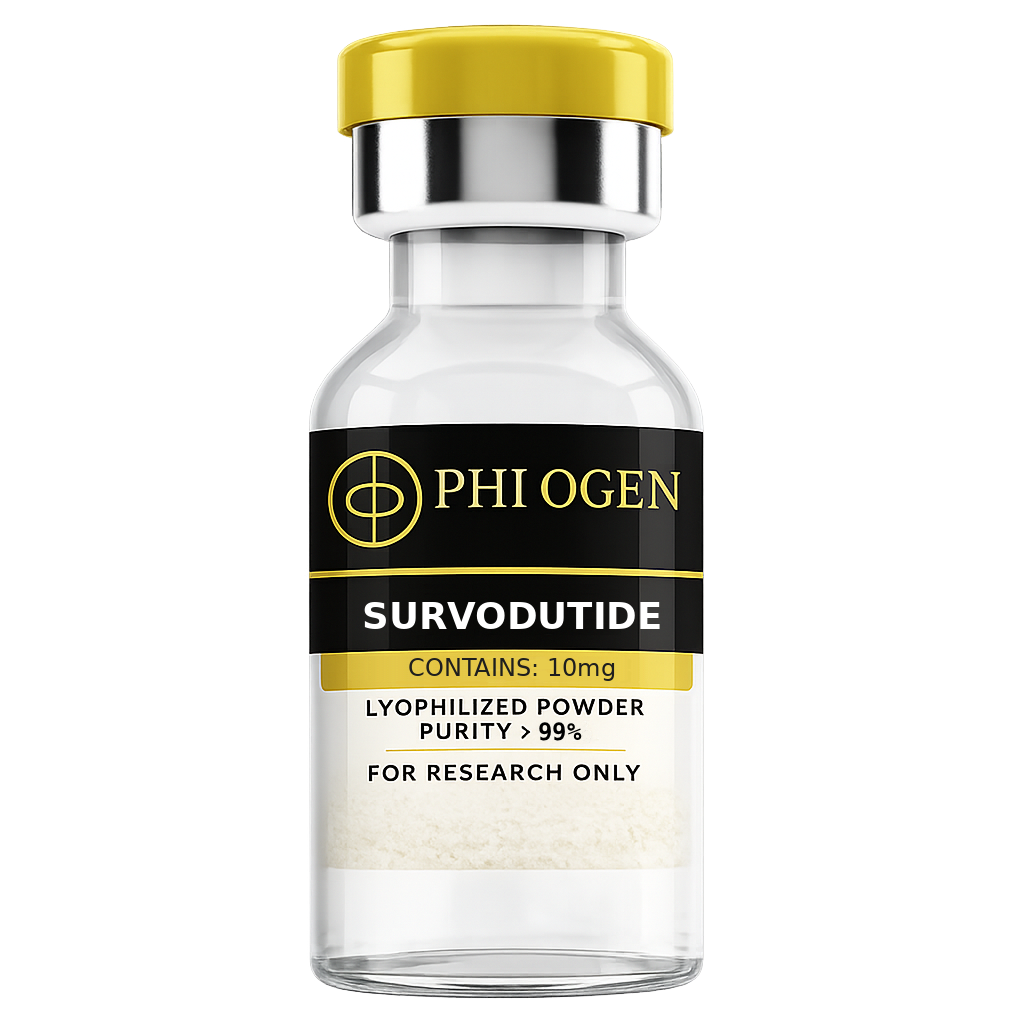
Survodutide 10mg
Dual GLP-1/Glucagon agonist — next-generation metabolic weight loss peptide.
14.9%
Avg body weight reduction
68wk
STEP-1 trial duration
FDA
Reviewed mechanism
Buy verified Survodutide 10mg. 98.8% purity. Dual GLP-1/Glucagon receptor agonist in Phase 3 trials for obesity.
Glucagon Receptor Adds Hepatic Dimension
Pure GLP-1 agonists drive weight loss primarily through appetite suppression. Survodutide's glucagon receptor agonism adds hepatic triglyceride mobilization and thermogenesis — a mechanistic dimension that produces superior MASH outcomes compared to semaglutide in head-to-head trial data.
Phase 3 MASH Potential Breakthrough
MASH (metabolic dysfunction-associated steatohepatitis) has virtually no approved pharmacological treatments. Survodutide's dual mechanism — weight loss plus direct hepatic fat reduction — positions it as one of the most compelling investigational agents for this high-unmet-need indication.
18–19% Weight Loss at 46 Weeks
Phase 2 weight reduction data places survodutide in the same efficacy tier as tirzepatide — significantly above the 14–15% achievable with semaglutide — while the glucagon component provides additional metabolic benefits outside the direct weight loss dimension.
Survodutide: Dual Agonist Weight Loss Protocol
Mechanism · Evidence · Application
Survodutide (BI 456906) is a dual GLP-1/Glucagon receptor agonist developed by Boehringer Ingelheim — one of the most clinically advanced non-semaglutide/tirzepatide weight loss peptides in late-stage development, with a distinct pharmacological profile driven by its significant glucagon receptor agonism alongside GLP-1 receptor activity. The glucagon component fundamentally distinguishes survodutide from pure GLP-1 agonists, adding hepatic fat mobilization and thermogenic metabolic effects that GLP-1 receptor activation alone does not provide.
The molecular mechanism of survodutide reflects its dual receptor profile. GLP-1 receptor agonism provides the established effects of this class: appetite suppression through hypothalamic signaling, delayed gastric emptying that reduces caloric intake and blunts postprandial glucose excursions, improved pancreatic insulin secretion in response to elevated glucose, and cardiovascular protective effects through GLP-1 receptor-expressing cardiac tissue. The simultaneous glucagon receptor agonism adds hepatic triglyceride lipolysis (glucagon drives hepatic fat mobilization), increased thermogenesis through brown adipose tissue activation, and additional hepatic metabolic effects that are particularly relevant for non-alcoholic fatty liver disease (NAFLD/MASH).
This dual activity produces a mechanistically differentiated weight loss and metabolic profile. Clinical trial data from Phase 2 studies demonstrates survodutide's efficacy: the SYNERGY-NASH trial in patients with MASH (metabolic dysfunction-associated steatohepatitis) showed survodutide produced significantly greater hepatic fat reduction than semaglutide comparators, with histological MASH resolution in a substantial proportion of participants. Body weight reduction in Phase 2 obesity trials reached 18–19% at 46 weeks — comparable to tirzepatide and approaching the efficacy ceiling of current GLP-1-based agents, while potentially offering superior hepatic benefits through the glucagon component.
The glucagon receptor agonism in survodutide requires careful pharmacological engineering — excess glucagon signaling drives hyperglycemia by stimulating hepatic glucose production, which would counteract the glucose-lowering GLP-1 component. Survodutide's dose ratio between GLP-1 and glucagon agonism is calibrated to achieve metabolic benefits from glucagon (hepatic fat, thermogenesis) without the glycemic liability, using the glucose-lowering GLP-1 component to offset potential glucagon-driven glucose elevation. This balance makes the ratio of dual agonism as pharmacologically significant as the absolute potency at each receptor.
Survodutide is currently in Phase 3 trials for obesity (SYNCHRONIZE program) and MASH — making it the most advanced GLP-1/glucagon dual agonist in clinical development. The MASH indication is of particular interest: MASH has extremely limited pharmacological treatment options, and survodutide's ability to combine appetite suppression, weight loss, and direct hepatic fat reduction through glucagon receptor agonism positions it as a potential breakthrough in this unmet need.
Research compound only. Protocol: doses ranging from 0.3mg to 4.8mg SC injection, with dose escalation to therapeutic target. Phase 2 studies used weekly subcutaneous injection.
Metabolic & Weight Loss Results
Dual GLP-1/Glucagon receptor agonism — metabolic profile mechanistically distinct from pure GLP-1 agonists
18–19% body weight reduction at 46 weeks in Phase 2 obesity trials — top-tier efficacy approaching tirzepatide
Superior hepatic fat reduction vs. semaglutide in SYNERGY-NASH trial — glucagon receptor hepatic lipolysis effect
MASH histological resolution in substantial proportion of Phase 2 NASH trial participants
Thermogenic enhancement through glucagon receptor-mediated brown adipose tissue activation
Hepatic triglyceride mobilization beyond GLP-1 — addresses fatty liver with a mechanism semaglutide lacks
GLP-1 component offsets glucagon glycemic liability — calibrated dual agonist balance
Currently in Phase 3 obesity and MASH trials (SYNCHRONIZE program) — most advanced non-sema/tirz agent
Addresses MASH — high unmet need indication with essentially no current pharmacological options
Weekly subcutaneous injection dosing — same administration convenience as leading GLP-1 agents
Weight Loss Protocol Guide
Survodutide 10mg Protocol Guide
Research Protocol — Survodutide:
· Route: Subcutaneous injection
· Frequency: Weekly (Phase 2 dosing schedule)
· Dose escalation: Start 0.3mg/week, escalate per tolerance over 12–16 weeks
· Target research doses: 2.4–4.8mg/week (Phase 2 efficacy range)
Phase 2 Trial Context:
· Obesity Phase 2: weekly SC injection, 46-week treatment period
· SYNERGY-NASH: weekly SC injection, primary endpoint hepatic fat change by MRI-PDFF
GI Tolerability:
· Nausea/vomiting most common adverse effects (class effect of GLP-1 agonism)
· Gradual dose escalation critical to minimize GI side effects
· Dose-dependent response — escalate to highest tolerated dose for efficacy
Stacking Context:
· Not recommended to stack with other GLP-1 or glucagon agonists (overlapping receptor targets)
· Can combine with MOTS-c or AICAR for AMPK-mediated metabolic complement
Note: Phase 3 trials ongoing (SYNCHRONIZE) — research compound, not approved
Body Composition
Dual GLP-1/Glucagon agonist — next-generation metabolic weight loss peptide.
Quality Assurance
HPLC Testing
Purity verified per batch
Mass Spectrometry
Molecular identity confirmed
Certificate of Analysis
Publicly available
US-Based Supplier
HPLC + Mass Spec Verified
Synergistic Combinations
Stack Survodutide 10mg With
Ready to Start?
Begin your Survodutide 10mg protocol
HPLC-tested and mass-spectrometry verified, with a Certificate of Analysis for every batch.
Get Survodutide 10mg