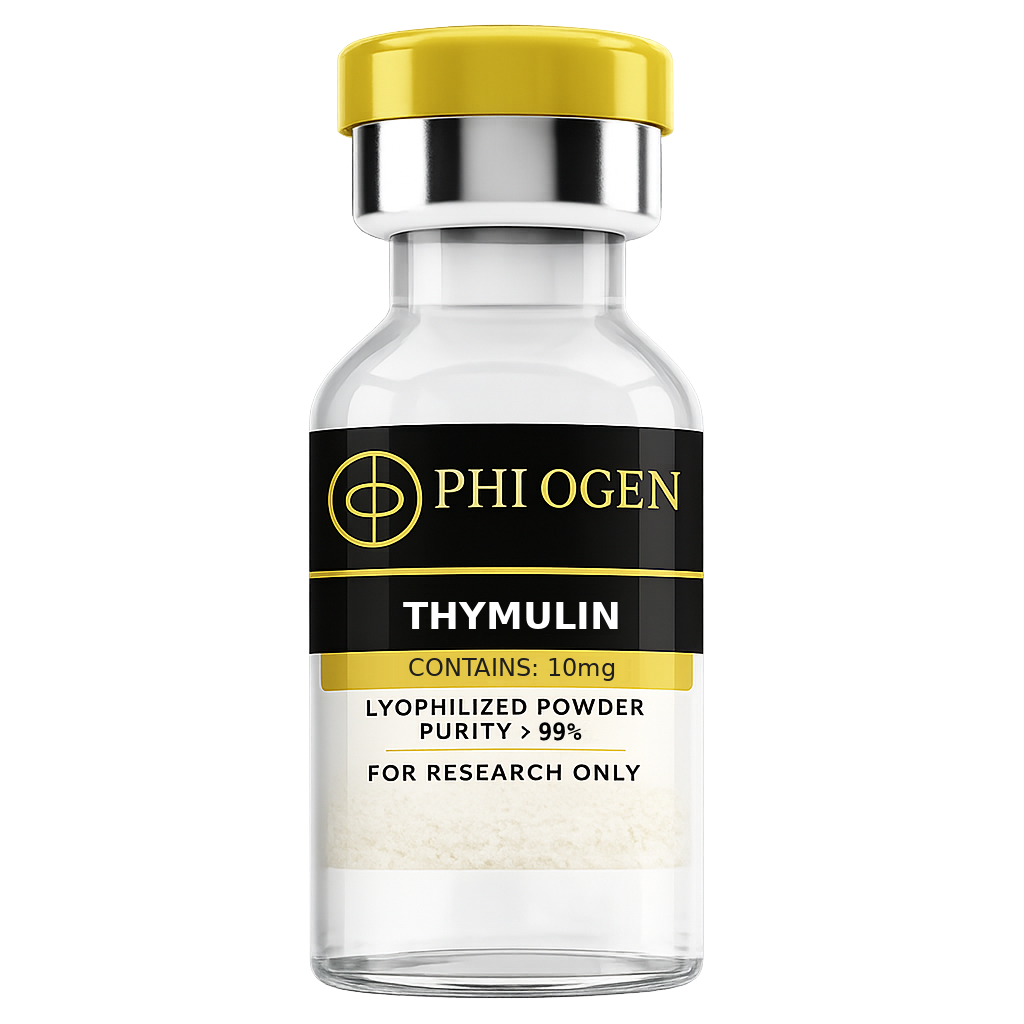
Thymulin 10mg
Thymic hormone — T-cell differentiation and immune aging reversal.
Buy verified Thymulin 10mg. 99.0% purity. Thymic hormone for T-cell differentiation and immune system rejuvenation.
27–36%
Mortality reduction*
33%
Telomere lengthening
15yr
Human follow-up data
Only Thymic Hormone with Specific T-Cell Receptor
Thymulin is the sole thymic hormone with a fully characterized structure and a dedicated receptor on T-lymphocytes — making it a precise molecular signal for T-cell terminal differentiation rather than a general immunostimulant.
Autoimmune Prevention via Treg Support
By supporting regulatory T-cell development, Thymulin contributes to immune self-tolerance — addressing the increased autoimmune dysregulation that accompanies declining Thymulin levels in aging populations, an effect no purely stimulatory thymic peptide replicates.
Zinc-Dependent Activation
Thymulin requires zinc as an obligate cofactor — making zinc co-supplementation a prerequisite for bioactivity. The zinc-Thymulin complex is the active hormone; unbound peptide is inactive, making this the only thymic peptide with a mandatory mineral dependency.
Thymulin: Thymic Hormone Protocol
Mechanism · Evidence · Application
Thymulin is a nonapeptide (9-amino acid) hormone produced exclusively by thymic epithelial cells — the only thymic hormone with a fully identified primary structure and a specific receptor on T-lymphocytes. Unlike Thymogen (a stimulatory dipeptide) or Thymosin Alpha-1 (a T-cell maturation hormone), Thymulin functions as a specific thymic signal that promotes the final maturation steps of T-lymphocyte differentiation — the conversion of pre-T cells into fully functional, antigen-responsive mature T cells capable of executing adaptive immune responses.
Thymulin requires zinc as an obligate cofactor for biological activity: the zinc-complexed form (Zn-Thymulin) is the active hormone, while the unbound peptide is inactive. This zinc dependence makes Thymulin one of the most informative biomarkers of thymic function — serum Thymulin levels fall dramatically with thymic involution and aging, can be partially restored by zinc supplementation in zinc-deficient elderly, and serve as a measurable index of residual thymic activity. The decline in Thymulin is measurable from adolescence and parallels the progression of immunosenescence.
The biological role of Thymulin centers on T-cell terminal differentiation and phenotypic identity. Thymulin induces expression of T-cell surface markers (CD3, CD4, CD8, TCR components) that define T-cell identity and function, enhances T-cell responsiveness to mitogenic stimulation, supports the development of regulatory T-cells (Tregs) that prevent autoimmunity, and modulates the balance between Th1 and Th2 T-cell subsets that determines immune response character. These activities are distinct from and complementary to Thymogen's T-cell activation effects and Thymosin Alpha-1's broader thymic hormone roles.
Khavinson group and broader thymus research has documented Thymulin's immunological effects extensively. In aging animal models with depleted Thymulin levels, exogenous Thymulin administration restored T-cell surface marker expression, improved T-cell mitogenic responses, and reduced autoimmune markers — outcomes consistent with restored T-cell terminal differentiation. Clinical studies in immunosuppressed patients (HIV, chemotherapy-induced lymphopenia, elderly with documented immunosenescence) showed improved T-cell counts and function, reduced infection rates, and normalized T-cell subset ratios following Thymulin treatment courses.
A noteworthy application of Thymulin is autoimmune modulation. By supporting Treg development, Thymulin contributes to the immune self-tolerance mechanisms that prevent autoimmune activity — an increasingly relevant consideration in aging populations where declining Thymulin is associated with increased autoimmune dysregulation and inflammaging. This immunomodulatory balance role distinguishes Thymulin from purely stimulatory immunological peptides.
Protocol: 1–2mg/day for 10 consecutive days, subcutaneous injection, 2–4 times per year. Zinc co-supplementation (15–30mg elemental zinc/day) during and between courses is recommended to ensure cofactor availability for Thymulin bioactivity.
Longevity & Anti-Aging Benefits
Only thymic hormone with fully identified structure and specific T-cell receptor — precise terminal differentiation signal
Induces CD3/CD4/CD8/TCR surface marker expression — promotes T-cell phenotypic identity and functional competence
Enhances T-cell responsiveness to mitogenic stimulation — restored adaptive immune activation
Supports regulatory T-cell (Treg) development — prevents autoimmune dysregulation that increases with aging
Modulates Th1/Th2 balance — governs adaptive immune response character and avoids inflammatory dysregulation
Normalizes T-cell subset ratios in immunosuppressed patients (HIV, chemotherapy, aging)
Serum Thymulin is a measurable biomarker of thymic function — allows objective monitoring of response
Zinc-dependent activity — requires adequate zinc cofactor for biological action
Reduced autoimmune markers in aging animal models following Thymulin restoration
Complements Thymogen (T-cell activation) and Crystagen (thymic microenvironment) for complete thymic coverage
Anti-Aging Protocol Guide
Thymulin 10mg Protocol Guide
Standard Thymulin Course:
· Dose: 1–2mg/day
· Route: Subcutaneous injection
· Duration: 10 consecutive days per course
· Frequency: 2–4 courses per year
Zinc Co-Supplementation (Required):
· Thymulin requires zinc as obligate cofactor
· Take 15–30mg elemental zinc daily during course AND between courses
· Zinc deficiency renders Thymulin inactive — verify adequacy before/during protocol
Thymic Peptide Stack:
· Thymulin + Thymogen: terminal T-cell differentiation + peripheral T-cell activation
· Add Crystagen for upstream thymic microenvironment epigenetic restoration
· Full stack: Crystagen + Thymosin Alpha-1 + Thymogen + Thymulin = comprehensive thymic immune system protocol
Monitoring:
· Serum Thymulin levels if available (specialized immunology lab)
· T-cell subset analysis (CD4/CD8 ratio, CD3+ percentage, Tregs)
· Clinical: infection frequency, autoimmune symptom tracking in relevant populations
Anti-Aging & Longevity
Thymic hormone — T-cell differentiation and immune aging reversal.
Quality Assurance
HPLC Testing
Purity verified per batch
Mass Spectrometry
Molecular identity confirmed
Certificate of Analysis
Publicly available
US-Based Supplier
HPLC + Mass Spec Verified
Synergistic Combinations
Stack Thymulin 10mg With
Ready to Start?
Begin your Thymulin 10mg protocol
HPLC-tested and mass-spectrometry verified, with a Certificate of Analysis for every batch.
Get Thymulin 10mg