VIP 10mg
Vasoactive Intestinal Peptide — immune modulation, gut health, and neuroprotection.
2×
Faster tissue repair
6–10wk
Standard protocol
5★
Evidence rating
Buy verified VIP 10mg. 98.8% purity. Vasoactive Intestinal Peptide — 28-amino acid neuropeptide with immune modulation, gut protection, and neuroprotective effects.
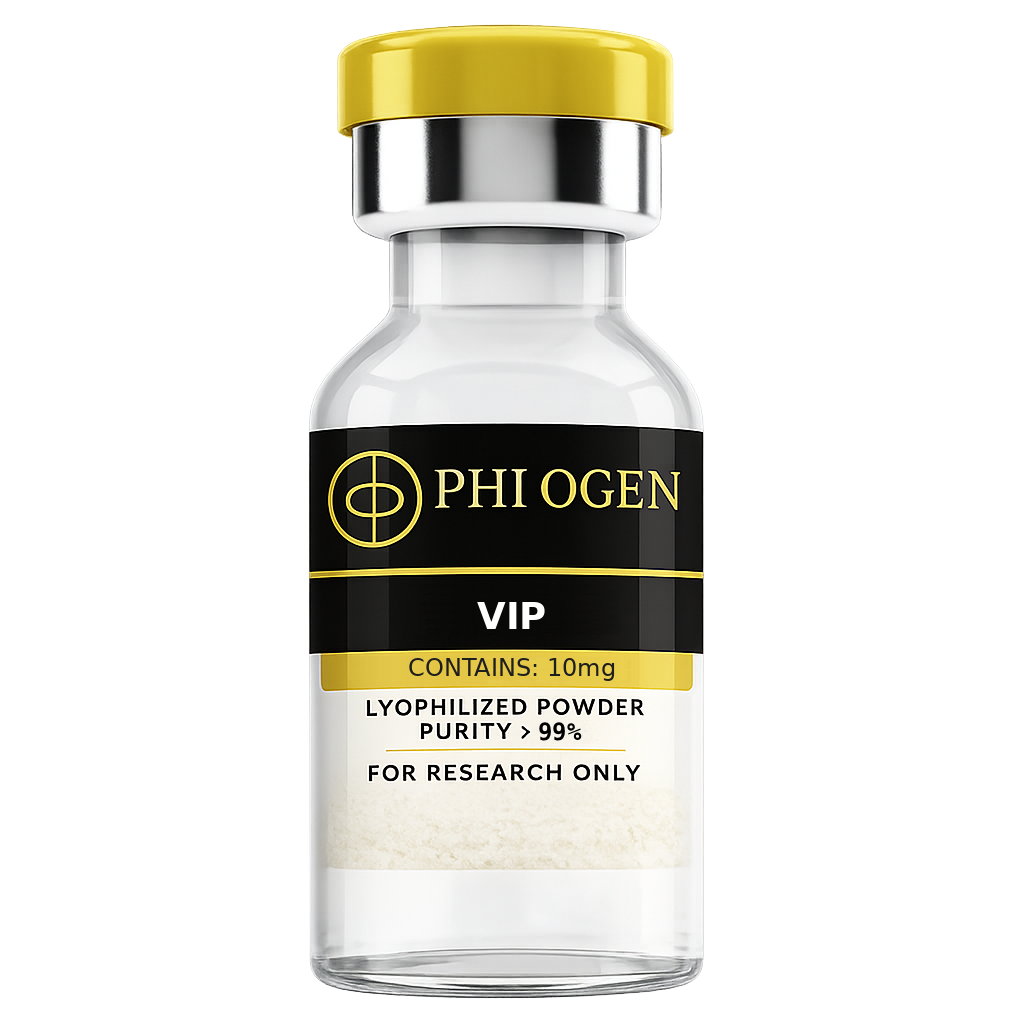
Research Grade · HPLC Tested
$125.99
$139.99
10% OFFHPLC tested · COA included
Order NowBroadest Distribution
VPAC1/VPAC2 receptors expressed in immune, GI, CNS, pulmonary, and cardiac tissue — VIP regulates more physiological systems than virtually any other single peptide.
Th1 to Treg Shift
VIP shifts immune balance from pro-inflammatory Th1 cytokines toward regulatory Treg and Th2 — one of the most potent endogenous immunomodulators known.
Circadian Pacemaker Signal
VIP is the primary neurotransmitter of the suprachiasmatic nucleus — the brain's master clock — making it uniquely relevant for circadian rhythm disruption.
VIP: Vasoactive Intestinal Peptide Protocol
Mechanism · Evidence · Application
VIP (Vasoactive Intestinal Peptide) is a 28-amino acid neuropeptide with one of the broadest tissue distributions and most diverse functional profiles of any peptide in biology. Originally named for its vasodilatory effects on intestinal blood vessels, VIP is now recognized as a central regulatory signal for the immune system, GI motility, circadian biology, pulmonary function, and neuroprotection — acting through VPAC1 and VPAC2 receptors expressed in virtually every tissue.
Multi-System Receptor Distribution
VPAC1 and VPAC2 receptors are G-protein-coupled receptors that activate adenylyl cyclase and increase intracellular cAMP. They are expressed in: - GI tract: Enteric neurons, smooth muscle, epithelial cells, immune cells - Immune system: T-cells, B-cells, macrophages, dendritic cells, mast cells - CNS: Hippocampus, suprachiasmatic nucleus (SCN), cortex, astrocytes - Lung: Pulmonary smooth muscle, pulmonary arterial endothelium - Heart: Cardiac myocytes and coronary vessels - Reproductive system: Uterine and ovarian tissue
This broad receptor distribution explains VIP's unusually wide-ranging effects — it is not a single-target compound but a systemic regulatory signal.
Immune Modulation: From Pro-Inflammatory to Regulatory
VIP is one of the most potent endogenous immunomodulators known. Its primary effect is shifting immune responses from pro-inflammatory Th1 toward anti-inflammatory Th2 and regulatory T-cell (Treg) phenotypes: - Reduces Th1 cytokines: IFN-γ, IL-2, TNF-α - Increases Th2 cytokines: IL-4, IL-5, IL-10 - Promotes regulatory T-cell differentiation and expansion - Inhibits activated macrophage pro-inflammatory cytokine production - Suppresses NF-κB in activated immune cells
These immunomodulatory effects make VIP theoretically relevant for autoimmune conditions, chronic inflammatory diseases, and MCAS (Mast Cell Activation Syndrome), where it reduces mast cell degranulation.
Gastrointestinal Effects
VIP is co-released with acetylcholine from non-adrenergic, non-cholinergic (NANC) enteric neurons and serves as a key regulator of GI function: - Relaxes GI smooth muscle — important for normal intestinal peristalsis and prevention of spasms - Stimulates intestinal epithelial chloride secretion and water transport - Protects gastric mucosa from acid damage (cytoprotective) - Regulates sphincter function in the GI tract - VIP deficiency in enteric neurons is associated with motility disorders
Neuroprotective Applications
VIP and its analog PACAP (pituitary adenylate cyclase-activating polypeptide) are among the most potent neuroprotective agents known in preclinical research: - Protects dopaminergic neurons in Parkinson's disease models - Reduces amyloid beta toxicity in Alzheimer's models - Promotes neurotrophic factor (BDNF, GDNF) expression - Protects neurons from excitotoxicity and oxidative stress - Anti-apoptotic in neurons through VPAC2 receptor / cAMP / PKA pathway
Circadian Biology
VIP is the primary neurotransmitter of the suprachiasmatic nucleus (SCN) — the brain's master circadian clock. VPAC2 receptor signaling synchronizes cellular circadian oscillators across the body to the central pacemaker. VIP deficiency in the SCN leads to arrhythmic circadian outputs, and VIP administration can help reset disrupted circadian rhythms in certain contexts.
Pulmonary Arterial Hypertension
VIP has been studied in Phase 2 trials for pulmonary arterial hypertension (PAH). Its pulmonary vasodilatory effects through VPAC1/VPAC2 on pulmonary vascular smooth muscle reduce pulmonary arterial pressure. Phase 2 data showed improvements in pulmonary hemodynamics and 6-minute walk distance, though the compound has not progressed to approval.
Healing & Repair Benefits
Most broadly distributed neuropeptide — VPAC1/VPAC2 receptors in immune, GI, CNS, pulmonary, and cardiac tissues
Shifts immune response from pro-inflammatory Th1 to regulatory Th2/Treg — potent anti-inflammatory immunomodulator
Reduces TNF-α, IFN-γ, IL-2 while increasing IL-4, IL-10 — comprehensive cytokine profile normalization
Mast cell degranulation suppression — relevant for MCAS and histamine-driven inflammatory conditions
GI motility regulation and mucosal cytoprotection through enteric NANC neurotransmission
Neuroprotection of dopaminergic neurons in Parkinson's models — GDNF/BDNF upregulation
Circadian pacemaker neurotransmitter in SCN — relevant for circadian rhythm disorders
Phase 2 PAH data: improvements in pulmonary hemodynamics and exercise capacity
Anti-apoptotic in neurons through VPAC2/cAMP/PKA survival signaling
98.8% purity with Certificate of Analysis
Dosing & Protocol Guide
VIP 10mg Protocol Guide
VIP Protocol:
· Dose: 50–500mcg per administration
· Route: Intranasal (CNS and upper respiratory access) or subcutaneous
· Frequency: Once or twice daily
· Duration: Continuous; no tolerance or desensitization documented
Immune Modulation Protocol:
· 100–200mcg subcutaneous once daily
· Particularly relevant for inflammatory conditions (IBD, autoimmune flares, MCAS)
· Effects on Treg expansion may require 4–8 weeks of consistent use
Intranasal for CNS/Neuroprotection:
· 100mcg per nostril (200mcg total)
· Provides direct CNS access via olfactory mucosa
· Morning dosing aligns with natural VIP circadian patterns
GI Protocol:
· 100mcg subcutaneous twice daily for intestinal motility and mucosal protection
· Stack with KPV or BPC-157 for comprehensive GI coverage
Reconstitution:
· Sterile saline preferred for intranasal use
· Bacteriostatic water for subcutaneous use
· 0.5–1mg/mL concentration for precise low-dose delivery
Healing & Recovery
Vasoactive Intestinal Peptide — immune modulation, gut health, and neuroprotection.
Quality Assurance
HPLC Testing
Purity verified per batch
Mass Spectrometry
Molecular identity confirmed
Certificate of Analysis
Publicly available
US-Based Supplier
HPLC + Mass Spec Verified
Synergistic Combinations
Stack VIP 10mg With
Ready to Start?
Begin your VIP 10mg protocol
HPLC-tested and mass-spectrometry verified, with a Certificate of Analysis for every batch.
Get VIP 10mg