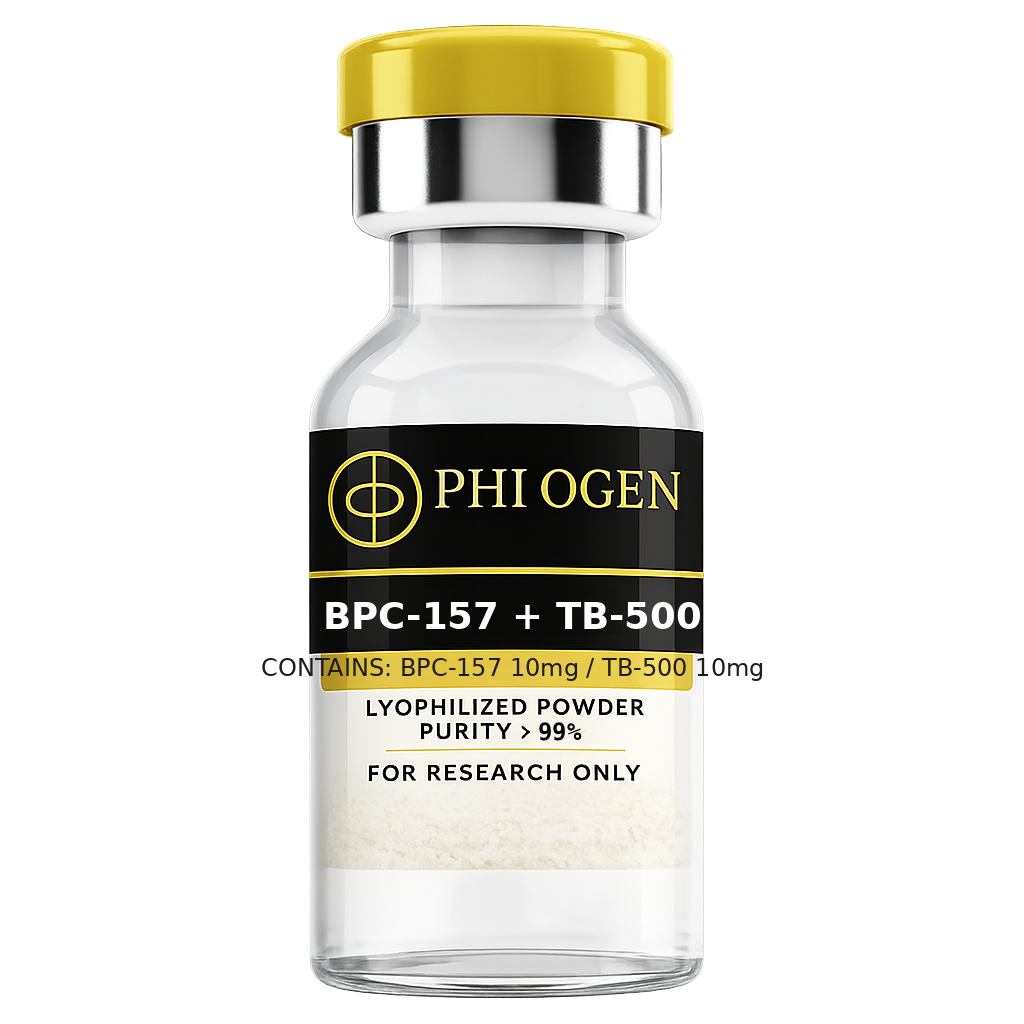
BPC-157 + TB-500 Blend 20mg
The gold-standard healing stack — BPC-157 and TB-500 combined in one vial.
High
Purity verified
COA
Batch certified
US
US supplier
Buy verified BPC-157 + TB-500 Blend 20mg (10mg each). 99.0% purity. The most popular healing stack combining local and systemic tissue repair.
Research Grade · HPLC Tested
$89.99
$99.99
10% OFFHPLC tested · COA included
Order NowThe Healing Peptide Stack
BPC-157 + TB-500 is the most widely used and most evidence-supported peptide combination for tissue healing — the two peptides cover the fundamental rate-limiting factors in repair (vascular supply and cell recruitment) through completely non-overlapping mechanisms that produce genuine synergy rather than redundancy.
BPC-157 Builds the Vascular Infrastructure
VEGF upregulation by BPC-157 drives new capillary formation that restores blood supply to avascular or hypovascular injury sites — without adequate blood supply, the cells and nutrients needed for tissue repair cannot reach the injury. BPC-157 solves the blood supply problem that limits all other repair mechanisms.
TB-500 Mobilizes the Repair Workforce
G-actin availability from TB-500's sequestration mechanism allows repair cells to rapidly reshape and migrate into injury sites, while Wnt/β-catenin stem cell signaling mobilizes regenerative cells from systemic sources. TB-500 solves the cellular recruitment problem that limits structural tissue rebuilding.
BPC-157 + TB-500 Blend: The Complete Healing Stack Protocol
Mechanism · Evidence · Application
The BPC-157 + TB-500 Blend 20mg combines 10mg of each peptide — the two most evidence-supported systemic tissue healing peptides available — in a single pre-blended vial that delivers dual-mechanism healing activation with single reconstitution convenience. This combination is often called the "healing stack" because the two peptides address tissue repair through complementary and largely non-overlapping molecular pathways: BPC-157 through growth factor upregulation, angiogenesis, and the GABAergic/nitric oxide systems; TB-500 through actin dynamics and systemic actin sequestration that redistributes cellular repair capacity to injury sites.
BPC-157's healing mechanism centers on its ability to upregulate growth factor receptors and stimulate angiogenesis (new blood vessel formation) at injury sites. BPC-157 upregulates VEGF (vascular endothelial growth factor) expression, activating the formation of new capillary networks in damaged tissue that restore blood supply essential for sustained repair. It also activates FAK-paxillin signaling in tendon and connective tissue fibroblasts, promoting cell migration and proliferation into injury sites. GH and IGF-1 receptor expression is upregulated by BPC-157, amplifying the anabolic signaling that drives tissue rebuilding. NO (nitric oxide) production modulation and EGR-1 transcription factor activation further coordinate BPC-157's multi-signal repair orchestration. These mechanisms are systemic — BPC-157 administered subcutaneously remote from the injury site still reaches the injury and activates local repair cascades.
TB-500 (Thymosin Beta-4 synthetic peptide) operates through the actin sequestration mechanism. Thymosin Beta-4 binds G-actin (globular, monomeric actin) to prevent its polymerization into F-actin (filamentous actin), maintaining a pool of free G-actin available for rapid cellular movement and shape changes. This actin availability enables faster migration of repair cells (fibroblasts, endothelial progenitors, inflammatory cells) into injury sites, accelerating the cellular recruitment phase of tissue repair. TB-500 also activates Wnt/β-catenin stem cell signaling, mobilizing stem cells from bone marrow and local tissue niches to injury sites — adding a regenerative cellular recruitment component absent from BPC-157's primarily growth factor-mediated mechanisms.
The two peptides are synergistic because they accelerate different phases and mechanisms of repair simultaneously: BPC-157 establishes the vascular supply and growth factor milieu; TB-500 accelerates cell migration and stem cell mobilization. Together, they address the two primary rate-limiting factors in tissue repair — inadequate blood supply to the injury site and insufficient recruitment of repair-competent cells to execute the rebuilding process. Neither alone produces as complete a repair-accelerating effect as both combined.
The 20mg vial (10mg BPC-157 + 10mg TB-500) at standard research doses (250mcg each per injection) provides approximately 40 combined doses — 8 weeks at 5× weekly, or 13 weeks at 3× weekly. This is the highest-dose blend option, suitable for acute injury protocols or for users who have established the lower-dose blend's tolerability.
Evidence-Backed Benefits
Dual-mechanism healing synergy: BPC-157 (growth factors + angiogenesis) + TB-500 (actin dynamics + stem cells)
VEGF upregulation by BPC-157 — new capillary formation restores blood supply to injury sites
FAK-paxillin fibroblast activation — accelerated connective tissue cell migration and proliferation
TB-500 actin sequestration — maintains free G-actin pool enabling rapid repair cell movement
Wnt/β-catenin stem cell mobilization from TB-500 — regenerative cell recruitment to injury site
Systemic delivery — both peptides reach injury sites from remote subcutaneous injection
Complementary rate-limiting factor coverage: vascular supply (BPC-157) + cellular recruitment (TB-500)
Pre-blended convenience — single reconstitution delivers both peptides simultaneously
20mg total = highest dose option for acute injury protocols
The most evidence-supported and widely used healing peptide combination available
Dosing & Protocol Guide
BPC-157 + TB-500 Blend 20mg Protocol Guide
BPC-157 + TB-500 Blend 20mg Protocol:
· Dose: 250mcg each (500mcg total blend) per injection
· Route: Subcutaneous injection (proximal to injury when possible)
· Frequency: Daily (acute injury) or 3–5× weekly (maintenance/prevention)
· Duration: 6–8 weeks for acute injury; ongoing for chronic conditions
Reconstitution:
· Add 4mL bacteriostatic water to 20mg vial (2.5mg/mL per peptide)
· 250mcg BPC-157 + 250mcg TB-500 = 0.2mL (200mcg/mL per peptide solution)
Acute Injury Protocol:
· Start within 24–48 hours of injury for maximum efficacy
· Daily injections for first 2 weeks, then 3–5× weekly for remaining 4 weeks
· Local SC injection near injury site preferred over distal injection
Maintenance Protocol:
· 3× weekly at maintenance doses
· For active athletes: year-round maintenance prevents chronic microtrauma accumulation
Monitoring:
· Imaging (MRI, ultrasound) at baseline and 6–8 weeks for structural outcome measurement
· Pain and functional scores as immediate clinical markers
BPC-157 + TB-500 Blend 20mg
HPLC Tested · COA Verified
$89.99
$99.99
10% OFFHPLC tested · COA verified
Blends & Stacks
The gold-standard healing stack — BPC-157 and TB-500 combined in one vial.
Quality Assurance
HPLC Testing
Purity verified per batch
Mass Spectrometry
Molecular identity confirmed
Certificate of Analysis
Publicly available
US-Based Supplier
HPLC + Mass Spec Verified
Synergistic Combinations
Stack BPC-157 + TB-500 Blend 20mg With
Ready to Start?
Begin your BPC-157 + TB-500 Blend 20mg protocol
HPLC-tested and mass-spectrometry verified, with a Certificate of Analysis for every batch.
Get BPC-157 + TB-500 Blend 20mg