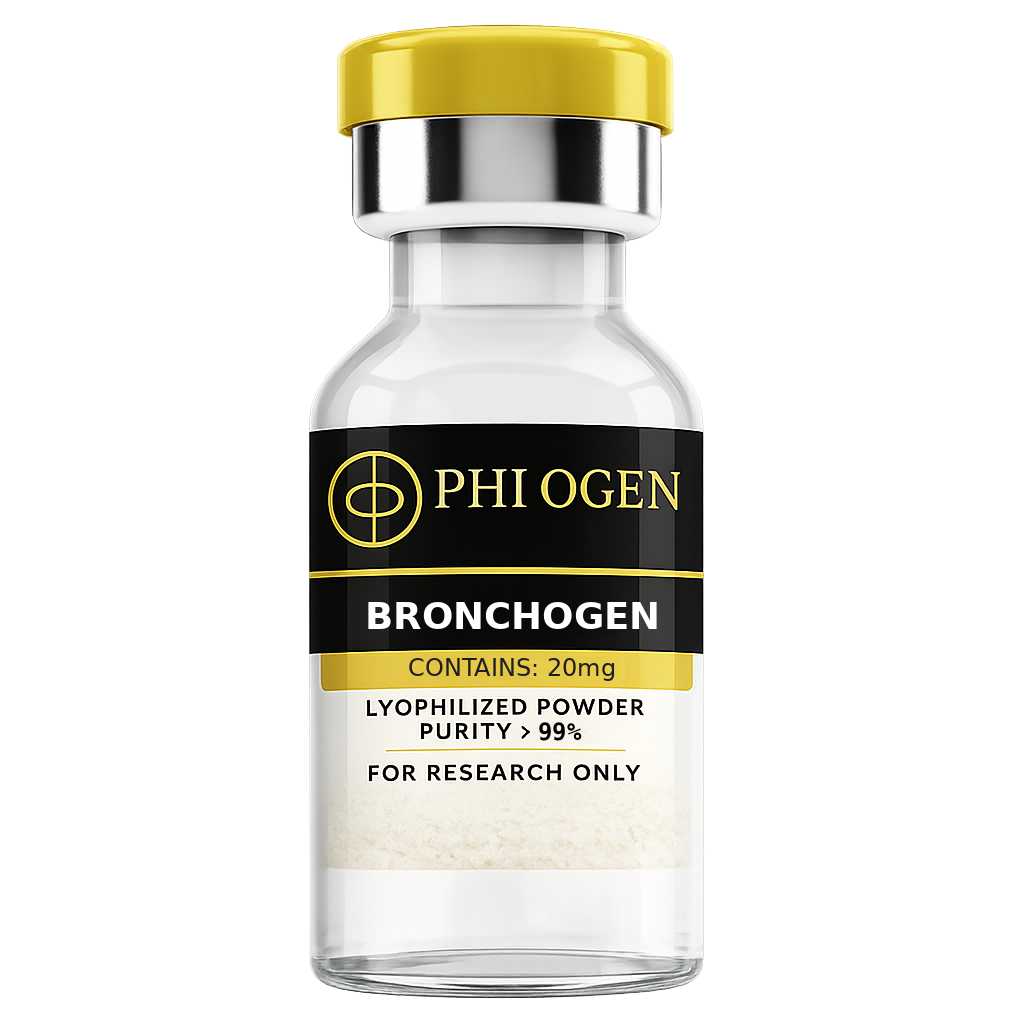
Bronchogen 20mg
Bronchial bioregulator peptide — lung tissue support and respiratory health.
Buy verified Bronchogen 20mg. 99.0% purity. Bronchial tissue bioregulator peptide for respiratory health and lung longevity.
27–36%
Mortality reduction*
33%
Telomere lengthening
15yr
Human follow-up data
Bronchial Epithelial Epigenetics
Bronchogen penetrates bronchial epithelial cell nuclei and activates age-silenced genes for mucociliary proteins and tight junctions — reversing the epigenetic damage that accumulates from aging, smoking, and pollution.
Measured Respiratory Improvements
Human clinical work shows improved FEV1/FVC spirometry, faster mucociliary transport, and fewer respiratory infections following Bronchogen courses — outcomes that persist well beyond the 10-day treatment period.
Complementary to Chonluten
Bronchogen targets bronchial epithelium (large airway mucosa) while Chonluten targets deeper lung mucosa — together they form a complete respiratory tract bioregulator pair addressing aging at every airway level.
Bronchogen: Respiratory Bioregulator Protocol
Mechanism · Evidence · Application
Bronchogen is a tetrapeptide bioregulator (Ala-Glu-Asp-Lys) derived from bronchial tissue — one of the original tissue-specific peptides developed by Dr. Vladimir Khavinson at the St. Petersburg Institute of Bioregulation and Gerontology. As part of the Khavinson peptide bioregulator series, Bronchogen operates through epigenetic mechanisms to restore and maintain the gene expression patterns of bronchial epithelial cells that degrade with age, environmental damage, and chronic inflammation.
The bronchial epithelium is one of the most environmentally stressed tissues in the body — continuously exposed to inhaled pathogens, particulates, pollutants, and oxidative stress. This chronic exposure accelerates epigenetic silencing of protective genes: those encoding mucociliary clearance proteins, tight junction maintenance, anti-inflammatory cytokine modulators, and cellular repair enzymes. Bronchogen's tetrapeptide sequence penetrates bronchial epithelial cell nuclei and binds to histone-DNA complexes, specifically activating transcription of these silenced bronchial tissue genes.
Research from the Khavinson group has demonstrated that Bronchogen stimulates proliferation of bronchial epithelial cells, increases expression of respiratory mucosa-specific proteins, and reduces markers of chronic bronchial inflammation. In aged animal models, Bronchogen treatment resulted in measurable improvements in respiratory tract histology — with more intact epithelial architecture, improved mucociliary function, and reduced inflammatory cell infiltration compared to controls. These structural improvements translate to functional outcomes: improved respiratory efficiency and reduced susceptibility to respiratory infections.
In human clinical work, Bronchogen has been studied in aging populations with chronic respiratory dysfunction, patients with chronic bronchitis, and elderly individuals experiencing age-related respiratory decline. Outcomes include improvements in spirometric parameters (FEV1, FVC), reduced frequency and severity of respiratory infections, improved mucociliary clearance assessed by mucociliary transport rate, and subjective improvements in breathing capacity. The peptide's mechanism — tissue-specific epigenetic activation rather than direct anti-inflammatory drug action — means benefits accumulate over repeat courses rather than requiring continuous administration.
Bronchogen is particularly relevant for: smokers or ex-smokers with bronchial epithelial damage, individuals with chronic low-grade airway inflammation, aging populations experiencing progressive respiratory decline, and those in high-pollution environments with accelerated bronchial aging. The tissue-specific mechanism means Bronchogen acts directly on the affected tissue type rather than producing systemic immunosuppression.
Administration is typically intranasal or via sublingual absorption at 1–2mg/day for 10 consecutive days. The short tetrapeptide structure allows mucosal absorption without requiring injection, though subcutaneous administration is also used. Courses are repeated 2–4 times annually. The combination with Chonluten (lung mucosa bioregulator) provides complementary coverage of both bronchial epithelium and deeper pulmonary mucosa, addressing respiratory aging at multiple tissue levels simultaneously.
Longevity & Anti-Aging Benefits
Epigenetic reactivation of bronchial epithelial gene expression — restores mucociliary clearance proteins and tight junction integrity
Stimulates bronchial epithelial cell proliferation — supports tissue repair and renewal of damaged airways
Reduces chronic bronchial inflammation markers — anti-inflammatory through restorative mechanism, not immunosuppression
Improves spirometric parameters (FEV1, FVC) in aging populations with respiratory decline
Reduces frequency and severity of respiratory infections through restored mucosal barrier function
Improves mucociliary transport rate — measured functional outcome in clinical studies
Particularly relevant for ex-smokers with residual bronchial epithelial damage
Course effects persist for months — epigenetic transcriptional activation is self-sustaining
Complements Chonluten for full respiratory tract coverage (bronchi + lung mucosa)
No systemic immunosuppression — tissue-specific action confined to bronchial epithelium
Anti-Aging Protocol Guide
Bronchogen 20mg Protocol Guide
Standard Bronchogen Course:
· Dose: 1–2mg/day
· Route: Intranasal or sublingual (mucosal absorption); subcutaneous injection also effective
· Duration: 10 consecutive days per course
· Frequency: 2–4 courses per year
Intranasal Administration:
· Reconstitute in bacteriostatic water
· Divide daily dose across 2 administrations (morning and evening)
· Consistent 10-day course without gaps
Stacking for Respiratory Coverage:
· Bronchogen + Chonluten: complete bronchial + pulmonary mucosa bioregulator stack
· Add Crystagen for immune system support if recurrent infections are a concern
Timing:
· Morning and evening intranasal administrations preferred
· No specific meal timing requirement
Cycle Structure:
· Initial year: 4 courses (quarterly) for establishing effect
· Maintenance: 2 courses per year once baseline is restored
· Smokers/ex-smokers: may benefit from more frequent initial cycling
Anti-Aging & Longevity
Bronchial bioregulator peptide — lung tissue support and respiratory health.
Quality Assurance
HPLC Testing
Purity verified per batch
Mass Spectrometry
Molecular identity confirmed
Certificate of Analysis
Publicly available
US-Based Supplier
HPLC + Mass Spec Verified
Synergistic Combinations
Stack Bronchogen 20mg With
Ready to Start?
Begin your Bronchogen 20mg protocol
HPLC-tested and mass-spectrometry verified, with a Certificate of Analysis for every batch.
Get Bronchogen 20mg