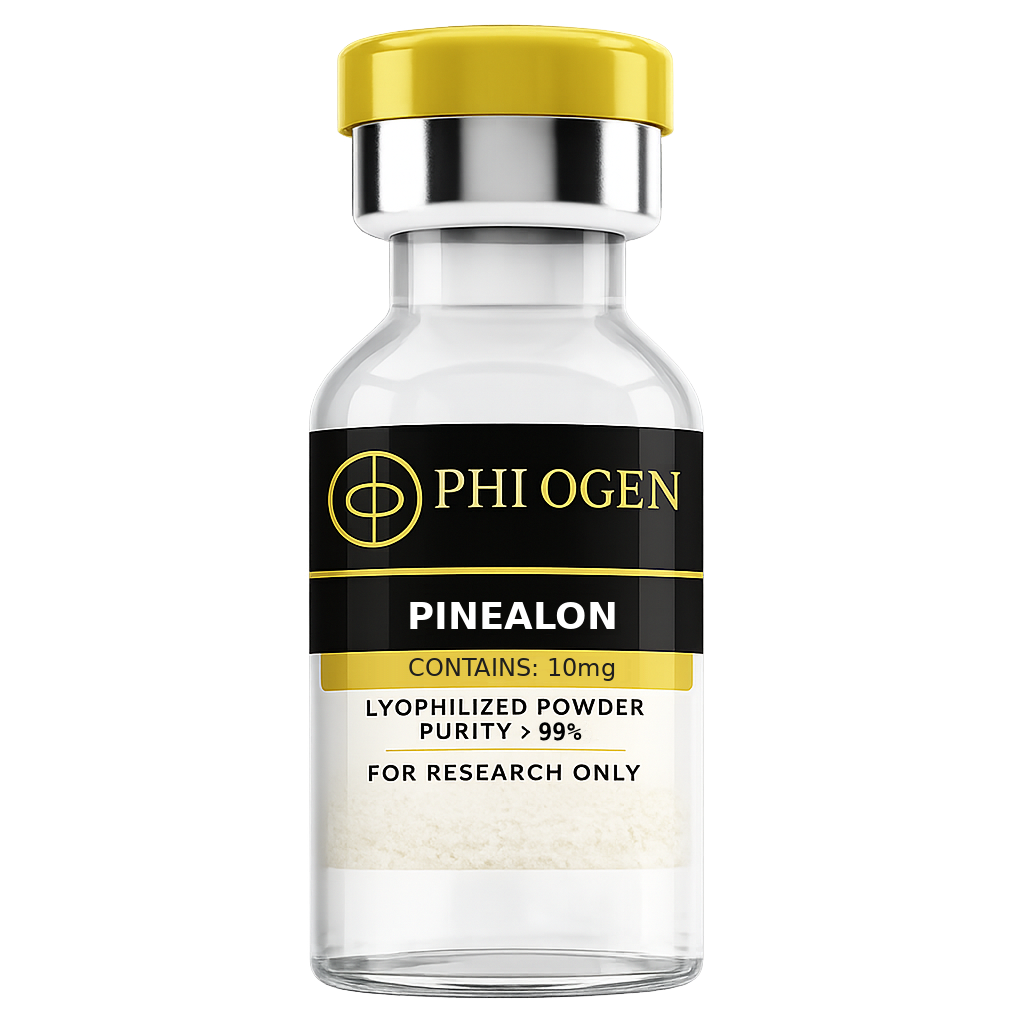
Pinealon 10mg
Pineal gland peptide — cognitive restoration and circadian regulation.
Buy verified Pinealon 10mg. 99.0% purity. Pineal gland tripeptide for neuroprotection and circadian rhythm normalization.
27–36%
Mortality reduction*
33%
Telomere lengthening
15yr
Human follow-up data
Epigenetic Pineal Restoration
Pinealon binds histone-DNA complexes in pineal cell nuclei, reactivating age-silenced genes for melatonin synthesis — an epigenetic mechanism that produces effects lasting months after course completion.
Lifespan Extension in Animal Models
Khavinson group data: Pinealon extended median lifespan 12–25% in aged rodent models — attributed to circadian normalization, antioxidant restoration, and neural epigenetic rejuvenation acting in concert.
Neuroprotection Beyond Sleep
Pinealon reduces neuronal apoptosis and improves functional recovery in ischemic brain models — positioning it beyond sleep support as a neural tissue protective agent for aging and injury contexts.
Pinealon: Pineal Peptide Neuroprotection Protocol
Mechanism · Evidence · Application
Pinealon is a synthetic tripeptide (Glu-Asp-Arg) derived from pineal gland tissue by Dr. Vladimir Khavinson at the St. Petersburg Institute of Bioregulation and Gerontology. As a tissue-specific bioregulator of the pineal gland — the organ responsible for melatonin synthesis and circadian master regulation — Pinealon works through epigenetic mechanisms to restore physiologically youthful gene expression patterns in neural and pineal cells.
The bioregulator mechanism that defines all Khavinson peptides is elegantly direct: short di-, tri-, and tetrapeptides penetrate cell nuclei and bind to histone-DNA complexes, activating the transcription of tissue-specific proteins that have been silenced by age-related chromatin compaction. Pinealon specifically upregulates expression of genes involved in melatonin synthesis, antioxidant defense, and pineal gland metabolic activity — effectively "unlocking" epigenetic silencing that accumulates in pineal tissue with age. This is distinct from pharmacological receptor stimulation; the effect is restorative rather than agonistic.
The pineal gland undergoes progressive calcification and functional decline with age — a process detectable by MRI by the third decade of life and accelerating significantly after 50. Pineal calcification correlates strongly with disrupted melatonin rhythms, poor sleep architecture, reduced antioxidant defense, and accelerated neurological aging. Pinealon targets this degradation at the gene expression level, supporting the cellular machinery responsible for melatonin production, tryptophan hydroxylase activity, and hydroxyindole-O-methyltransferase (HIOMT) expression.
Clinically, Khavinson and colleagues have published extensively on Pinealon's effects across multiple human and animal studies. Animal studies demonstrate significant increases in pineal melatonin output following Pinealon administration, with corresponding improvements in sleep architecture, antioxidant enzyme activity (superoxide dismutase, catalase), and resistance to oxidative neural damage. In aged animal models, Pinealon treatment extended median lifespan by 12–25% in multiple experimental series — findings the Khavinson group attributes to combined effects on circadian normalization, oxidative stress reduction, and epigenetic rejuvenation of neural tissue.
Human studies have focused on aging populations with compromised circadian function — insomnia in the elderly, shift workers with chronic circadian misalignment, and patients with neurodegenerative disease. Results consistently show improved sleep quality, reduced nocturnal waking, normalized melatonin rhythm amplitude, and subjective improvements in cognitive clarity and energy. Importantly, these effects persist for weeks after the peptide course ends — consistent with the epigenetic mechanism, where transcriptional "re-activation" sustains itself beyond the peptide's presence.
Neurological applications extend beyond sleep. Pinealon has demonstrated neuroprotective effects in models of ischemic brain injury, with reduced neuronal loss and improved functional recovery when administered peri-ischemia. The proposed mechanisms include: suppression of apoptotic cascades in neural tissue, enhancement of endogenous antioxidant defenses, and maintenance of mitochondrial membrane potential in neurons under oxidative stress. These effects position Pinealon as a candidate adjunct for age-related cognitive decline, post-stroke recovery, and neurodegenerative conditions — though human clinical trials in these applications are limited to the Khavinson group's observational work.
Standard Pinealon protocol is 10mg/day for 10 consecutive days, administered intranasally or sublingually (the tripeptide is small enough for mucosal absorption), or via subcutaneous injection. Courses are typically repeated 2–4 times per year with 3–6 month intervals between cycles. The extended effect duration means more frequent administration is generally unnecessary. Combination with Epithalon (the pineal-derived telomerase activator) represents a synergistic approach to comprehensive pineal-neural rejuvenation.
Longevity & Anti-Aging Benefits
Epigenetic reactivation of silenced pineal gland gene expression — restores melatonin synthesis machinery
Increases pineal melatonin output in aged tissue — measured in animal studies following Pinealon treatment
Improves sleep architecture: reduced sleep latency, fewer nocturnal awakenings, deeper slow-wave sleep
Antioxidant defense enhancement — upregulates SOD, catalase in neural tissue
Neuroprotective in ischemic models — reduces neuronal apoptosis and improves functional recovery
Extended effect duration post-course — epigenetic changes sustain transcriptional activity
Median lifespan extension 12–25% in aged animal models across multiple experimental series
Circadian normalization — restores amplitude of melatonin rhythm blunted by pineal calcification
Cognitive clarity improvement — reported in aging populations with disrupted melatonin cycles
Safe long-term cycling protocol — minimal systemic effects due to tissue-specific gene targeting
Anti-Aging Protocol Guide
Pinealon 10mg Protocol Guide
Standard Pinealon Course:
· Dose: 10mg/day
· Route: Intranasal, sublingual, or subcutaneous injection
· Duration: 10 consecutive days per course
· Frequency: 2–4 courses per year, with 3–6 month intervals
Intranasal Administration:
· Reconstitute in bacteriostatic water (1mg/mL concentration)
· 10mg split across 2–4 intranasal doses throughout day
· Mucosal absorption bypasses first-pass metabolism
Timing:
· Evening administration preferred (aligns with melatonin rhythm support)
· Consistent daily timing more important than specific clock time
Stacking:
· Combine with Epithalon for comprehensive pineal rejuvenation
· Can stack with Cortagen for broader neuro-bioregulator coverage
· Compatible with melatonin supplementation (additive, not redundant)
Cycle Structure:
· Year 1: 4 courses recommended for established effect
· Maintenance: 2 courses/year once effects are established
· Effects persist 3–6 months after course completion
Anti-Aging & Longevity
Pineal gland peptide — cognitive restoration and circadian regulation.
Quality Assurance
HPLC Testing
Purity verified per batch
Mass Spectrometry
Molecular identity confirmed
Certificate of Analysis
Publicly available
US-Based Supplier
HPLC + Mass Spec Verified
Synergistic Combinations
Stack Pinealon 10mg With
Ready to Start?
Begin your Pinealon 10mg protocol
HPLC-tested and mass-spectrometry verified, with a Certificate of Analysis for every batch.
Get Pinealon 10mg