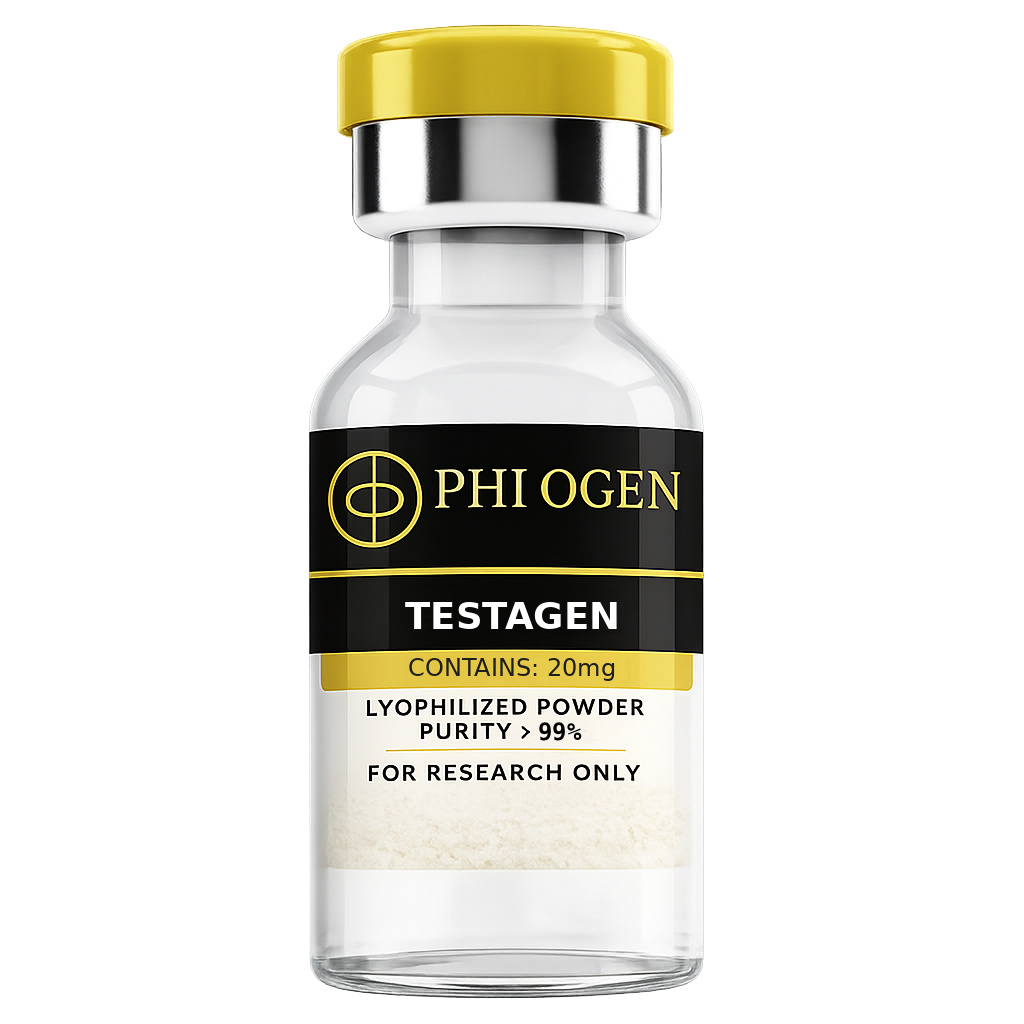
Testagen 20mg
Testes bioregulator peptide — gonadal tissue support for men's hormonal longevity.
Buy verified Testagen 20mg. 99.0% purity. Testicular tissue bioregulator for men's hormonal health and longevity.
27–36%
Mortality reduction*
33%
Telomere lengthening
15yr
Human follow-up data
Endogenous Production Restoration
Testagen reactivates the steroidogenic enzyme genes in Leydig cells that produce testosterone — restoring the cellular machinery for endogenous production rather than bypassing it with exogenous hormone.
HPG Axis Preservation
Because Testagen restores testicular testosterone production rather than supplementing it externally, pituitary LH/FSH signaling remains intact — preserving natural pulsatility, feedback regulation, and fertility that TRT eliminates.
Upstream Epigenetic Intervention
Testosterone decline begins as epigenetic silencing of steroidogenic genes in Leydig cells decades before andropause symptoms appear. Testagen intervenes at this epigenetic origin point — addressing the cause rather than supplementing around it.
Testagen: Gonadal Bioregulator Protocol
Mechanism · Evidence · Application
Testagen is a bioregulator peptide targeting testicular tissue — the primary site of testosterone synthesis and spermatogenesis in men. Developed by Dr. Vladimir Khavinson at the St. Petersburg Institute of Bioregulation and Gerontology, Testagen activates gene expression in Leydig cells (testosterone-producing) and Sertoli cells (spermatogenesis-supporting) that progressively silences with age — the epigenetic contribution to the androgen decline that begins in men's third and fourth decades and accelerates significantly after 50.
Testosterone is the master anabolic hormone of the male body: governing muscle mass, bone density, libido, red blood cell production, mood, cognitive function, and metabolic efficiency. Age-related testosterone decline (andropause) is one of the most consequential hormonal changes in male aging — yet unlike female menopause, it occurs gradually and is often attributed to "normal aging" rather than recognized as a treatable or addressable endocrine change. The epigenetic component of this decline — progressive silencing of steroidogenic genes in Leydig cells — is exactly what Testagen targets.
Testagen's peptide sequence penetrates Leydig cell and Sertoli cell nuclei and binds to histone-DNA complexes, reactivating transcription of testicular functional genes. In Leydig cells, these include the steroidogenic enzyme genes (StAR, CYP11A1, 3β-HSD, CYP17A1, 17β-HSD) that constitute the testosterone synthesis pathway, LH receptor genes enabling pituitary-gonadal axis signaling, and anti-apoptotic factors maintaining Leydig cell viability. In Sertoli cells, Testagen activates genes for androgen-binding protein (ABP), inhibin, FSH receptor, and structural support proteins required for spermatogenesis.
Research from the Khavinson group demonstrates measurable effects on testicular function. In aging animal models, Testagen treatment increased testicular weight (a proxy for Leydig cell and seminiferous tubule mass), elevated serum testosterone levels compared to untreated aging controls, improved histological markers of spermatogenesis quality, and reduced apoptotic markers in testicular cell populations. The testosterone elevation mechanism is distinct from exogenous testosterone administration — rather than replacing testosterone, Testagen restores the cellular machinery that produces testosterone endogenously, maintaining pituitary-gonadal feedback and avoiding the testicular atrophy and fertility suppression that accompany exogenous testosterone.
Human clinical applications in the Khavinson group's work have focused on aging men with documented testosterone decline and hypogonadal symptoms, fertility concerns in aging males, and preventive protocols for men seeking to maintain endocrine health. Outcomes include improvements in serum testosterone levels, FSH/LH axis normalization, improvements in male sexual health parameters, and subjective improvements in energy, libido, and mood consistent with testosterone restoration.
The key distinction from testosterone replacement therapy (TRT): Testagen works upstream at the epigenetic level to restore endogenous testosterone production, preserving natural pulsatility, HPG axis feedback, and fertility — outcomes impossible with exogenous testosterone supplementation. Protocol: 2mg/day for 10 consecutive days, subcutaneous injection, 2–4 courses per year.
Longevity & Anti-Aging Benefits
Epigenetic reactivation of Leydig cell steroidogenic genes — StAR, CYP11A1, CYP17A1, 17β-HSD in testosterone synthesis pathway
Elevated endogenous testosterone in aging animal models — restored biosynthesis rather than exogenous replacement
Preserves HPG axis integrity — maintains pituitary feedback and natural testosterone pulsatility
No testicular atrophy — unlike exogenous testosterone which suppresses LH and causes testicular shrinkage
Sertoli cell gene activation — supports spermatogenesis and fertility alongside testosterone restoration
Improved testicular histology in aging animals — better preserved seminiferous tubule architecture
Improved male sexual health parameters in human clinical work
Mood, energy, and libido improvements consistent with testosterone restoration
Works upstream of testosterone — restores the cellular machinery for production rather than bypassing it
Complements Prostamax for complete male reproductive system bioregulator coverage
Anti-Aging Protocol Guide
Testagen 20mg Protocol Guide
Standard Testagen Course:
· Dose: 2mg/day
· Route: Subcutaneous injection preferred
· Duration: 10 consecutive days per course
· Frequency: 2–4 courses per year
Timing:
· Morning administration aligns with natural testosterone production peak
· No specific food restriction
Male Hormonal Stack:
· Testagen + Prostamax: complete testicular + prostate bioregulator pair
· Testagen + Kisspeptin-10: epigenetic Leydig cell restoration + upstream HPG pulsatile signaling support
Monitoring:
· Serum total and free testosterone at baseline and 6 weeks after course completion
· LH/FSH to confirm HPG axis maintenance (should remain active, unlike with TRT)
· SHBG for complete hormonal picture
vs. TRT:
· Testagen restores endogenous production — HPG axis preserved, fertility maintained
· TRT replaces testosterone externally — HPG suppressed, testicular function reduced
· For men wanting to maintain natural production rather than replace it, Testagen addresses the epigenetic root
Anti-Aging & Longevity
Testes bioregulator peptide — gonadal tissue support for men's hormonal longevity.
Quality Assurance
HPLC Testing
Purity verified per batch
Mass Spectrometry
Molecular identity confirmed
Certificate of Analysis
Publicly available
US-Based Supplier
HPLC + Mass Spec Verified
Synergistic Combinations
Stack Testagen 20mg With
Ready to Start?
Begin your Testagen 20mg protocol
HPLC-tested and mass-spectrometry verified, with a Certificate of Analysis for every batch.
Get Testagen 20mg