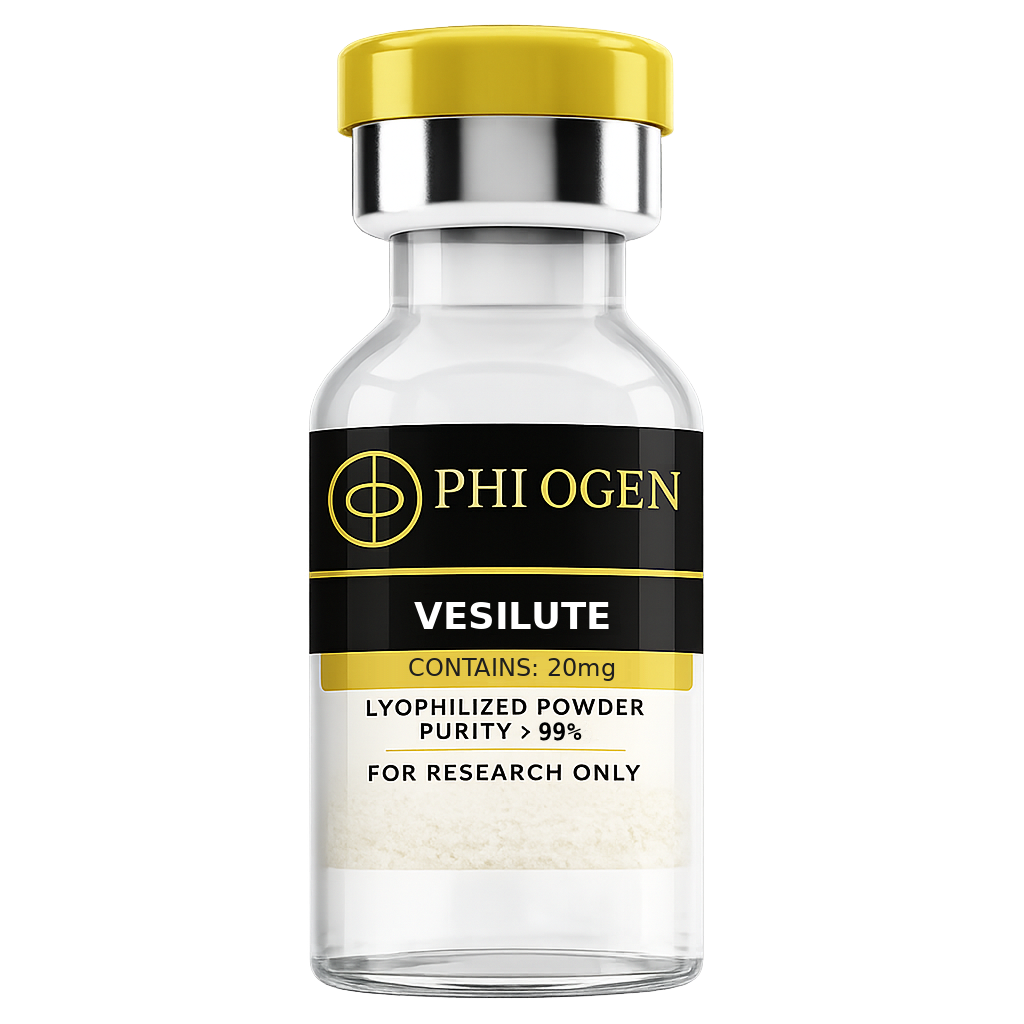
Vesilute 20mg
Bladder tissue bioregulator peptide.
Buy verified Vesilute 20mg. 99.0% purity. Bladder tissue bioregulator peptide for urological health.
27–36%
Mortality reduction*
33%
Telomere lengthening
15yr
Human follow-up data
Urothelial Barrier Epigenetic Restoration
Vesilute reactivates uroplakin and tight junction gene expression in urothelial cells — rebuilding the specialized barrier that prevents urine components from penetrating the bladder wall and sensitizing the sensory nerves driving urgency and frequency.
Causal vs. Symptomatic Treatment
Anticholinergics and beta-3 agonists suppress bladder contractions to manage symptoms. Vesilute restores the urothelial barrier dysfunction that causes the sensitization — an upstream causal intervention that anticholinergics cannot address.
Quality-of-Life Impact
Improved bladder capacity, reduced nocturia, and fewer urgency episodes represent direct quality-of-life improvements for one of the most common and underaddressed aging conditions — lower urinary tract symptoms affecting the majority of people over 60.
Vesilute: Bladder Bioregulator Protocol
Mechanism · Evidence · Application
Vesilute is a peptide bioregulator targeting bladder epithelial tissue (urothelium) — one of the more specialized organ-specific peptides in the Khavinson bioregulator series developed at the St. Petersburg Institute of Bioregulation and Gerontology. As a tissue-specific short peptide derived from bladder tissue, Vesilute activates gene expression in urothelial cells that has been progressively silenced by aging, chronic mechanical stress, recurrent infection, and inflammatory damage — the epigenetic root of the age-related bladder dysfunction that affects a substantial portion of aging populations.
The urothelium is a highly specialized transitional epithelium with unique structural properties: it must be impermeable to urine components (ions, urea, organic acids) while withstanding continuous mechanical stretch and relaxation as the bladder fills and empties. Urothelial cells express specialized proteins — uroplakins (UP Ia, Ib, II, III), tight junction components, and barrier lipids — that maintain this impermeability. With aging, expression of these barrier genes progressively declines, leading to urothelial permeability increases, penetration of urine components into the bladder wall, sensory nerve sensitization, and the urgency, frequency, and pain symptoms characteristic of bladder aging syndrome.
Vesilute's peptide sequence penetrates urothelial cell nuclei and reactivates transcription of these barrier and functional genes — uroplakin expression, tight junction proteins (claudins, occludins), anti-inflammatory genes that reduce sensory sensitization, and growth factors supporting urothelial self-renewal. The restoration of urothelial barrier integrity directly addresses the mechanism underlying overactive bladder symptoms, increased infection susceptibility, and the painful bladder conditions associated with urothelial compromise.
Khavinson group research on Vesilute has examined its effects in aging animal bladder tissue and in human populations with age-related lower urinary tract symptoms (LUTS). Animal studies demonstrate improved urothelial histology following Vesilute treatment — better preserved barrier architecture, higher uroplakin expression, and reduced inflammatory infiltration in bladder wall tissue. Human clinical outcomes include improvements in urinary frequency, reduced nocturia, improved bladder capacity, and reduced urinary urgency episodes — outcomes that directly improve quality of life for the substantial aging population affected by LUTS.
The mechanism is meaningfully different from anticholinergic drugs and beta-3 agonists used for overactive bladder: those compounds reduce detrusor muscle contractility or block muscarinic receptors to suppress urgency symptoms. Vesilute addresses the upstream urothelial barrier dysfunction that sensitizes sensory nerves and drives the urgency sensation — a causal intervention rather than symptomatic management. For post-menopausal women and aging men where urothelial atrophy is a significant contributor to LUTS, Vesilute's epigenetic restoration approach targets the actual tissue pathology.
Protocol: 2mg/day for 10 consecutive days, subcutaneous or intranasal, repeated 2–4 times per year.
Longevity & Anti-Aging Benefits
Epigenetic reactivation of urothelial barrier gene expression — uroplakins, tight junctions, barrier lipids
Restores urothelial impermeability — prevents urine component penetration that sensitizes sensory nerves
Improved bladder capacity and reduced urinary frequency in human clinical outcomes
Reduced nocturia and urgency episodes — direct quality-of-life improvement
Addresses urothelial barrier dysfunction upstream of muscarinic/beta-3 symptom management
Better preserved urothelial histological architecture in aging animal bladder tissue
Reduced inflammatory infiltration in bladder wall — anti-inflammatory gene activation
Supports urothelial self-renewal — growth factor gene activation for epithelial maintenance
Particularly relevant for post-menopausal women and aging men with urothelial atrophy
Complements Prostamax for comprehensive lower urinary tract bioregulator coverage in men
Anti-Aging Protocol Guide
Vesilute 20mg Protocol Guide
Standard Vesilute Course:
· Dose: 2mg/day
· Route: Subcutaneous injection or intranasal
· Duration: 10 consecutive days per course
· Frequency: 2–4 courses per year
Lower Urinary Tract Stack:
· Vesilute + Prostamax (men): complete bladder epithelium + prostate bioregulator pair
· Vesilute alone (women): urothelial barrier restoration for post-menopausal LUTS
Monitoring:
· Voiding diary: frequency, nocturia episodes, urgency scale at baseline and after course
· Bladder capacity (cystometrogram if available) for objective measure
· Quality of life questionnaire (OAB-q, ICIQ) for standardized outcome tracking
vs. Anticholinergics/Beta-3 Agonists:
· Standard LUTS drugs suppress detrusor contractility — symptom management
· Vesilute restores urothelial barrier — causal tissue repair
· Can be used alongside pharmacological treatment; addresses different mechanism
Anti-Aging & Longevity
Bladder tissue bioregulator peptide.
Quality Assurance
HPLC Testing
Purity verified per batch
Mass Spectrometry
Molecular identity confirmed
Certificate of Analysis
Publicly available
US-Based Supplier
HPLC + Mass Spec Verified
Synergistic Combinations
Stack Vesilute 20mg With
Ready to Start?
Begin your Vesilute 20mg protocol
HPLC-tested and mass-spectrometry verified, with a Certificate of Analysis for every batch.
Get Vesilute 20mg