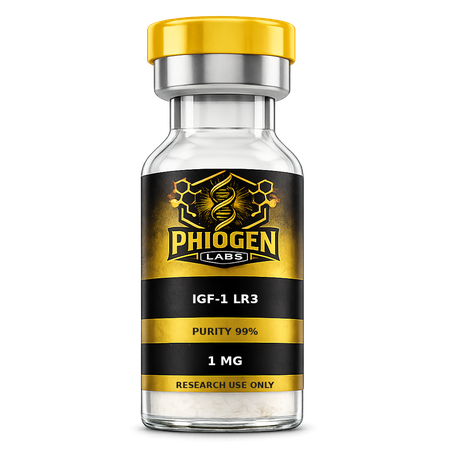
IGF-1 LR3
Insulin-like Growth Factor-1 Long Arg3 — direct anabolic signaling for peak muscle growth.
3–5×
Natural GH pulse
12–24wk
Optimal cycle
0
Receptor desensitization
IGF-1 LR3 is a modified form of Insulin-like Growth Factor-1 with 13× longer half-life. It directly signals muscle cell proliferation and hypertrophy — the downstream anabolic effector of GH.

Apollo Peptides Sciences
$79.99
HPLC tested · COA included
Buy from ApolloOpens apollopeptidesciences.com (affiliate link)
Hyperplasia
One of the only compounds capable of stimulating new muscle fiber creation (hyperplasia) rather than just enlarging existing cells.
Bioavailability
13× longer half-life than native IGF-1 due to reduced IGFBP binding — more sustained anabolic signal.
Short Cycles
Must be limited to 4–6 week cycles due to receptor desensitization — this is a feature, not a drawback.
IGF-1 LR3: The Direct Anabolic Protocol Guide
Mechanism · Evidence · Application
IGF-1 LR3 (Insulin-like Growth Factor-1 Long Arg3) is a modified version of the naturally occurring IGF-1 peptide. The LR3 variant has an arginine-glutamate substitution at position 3 and an 8-amino-acid N-terminal extension that dramatically reduces its binding to IGF binding proteins (IGFBPs) — the proteins that inactivate most circulating IGF-1. The result is a 13× longer half-life (20–30 hours vs. 15–90 minutes for native IGF-1) and significantly enhanced bioavailability.
The GH → IGF-1 Axis
IGF-1 is the primary anabolic downstream effector of growth hormone. When GH stimulates the liver and peripheral tissues, they produce IGF-1, which then acts on muscle, bone, and connective tissue to drive growth and repair. IGF-1 LR3 bypasses the GH pituitary step entirely, delivering direct anabolic signaling to muscle tissue.
Mechanism: Hyperplasia vs. Hypertrophy
IGF-1's unique advantage over anabolic steroids is its ability to stimulate muscle hyperplasia — the creation of new muscle fiber cells — not just hypertrophy (enlargement of existing cells). New muscle fibers represent permanent genetic changes to muscle architecture, making IGF-1 LR3 gains more durable than those from other anabolic agents.
Cycling Requirement
Due to receptor desensitization, IGF-1 LR3 must be cycled in short 4–6 week bursts. Continuous use leads to receptor downregulation and diminishing returns. Most protocols run 4–6 weeks on, minimum 4 weeks off.
GH Optimization Benefits
Direct anabolic signaling to muscle tissue — bypasses the GH-liver axis
Stimulates muscle hyperplasia (new fiber creation) — not just hypertrophy
Dramatically accelerates recovery between training sessions
Enhances nutrient partitioning — directs calories to muscle over fat
13× longer half-life than native IGF-1 for sustained anabolic environment
Synergistic with GH peptides (Ipamorelin/CJC) for complete GH axis optimization
Potential for permanent muscle architecture changes via hyperplasia
Improves connective tissue strength and injury resistance
Dosing & Cycle Guide
IGF-1 LR3 Protocol Guide
Cycle Protocol (4–6 weeks only):
· Dose: 40–60mcg per injection
· Timing: Post-workout (within 30 minutes of training completion)
· Route: Subcutaneous or intramuscular injection
· Frequency: Daily on training days; skip on rest days
Off-Cycle:
· Minimum 4 weeks off between cycles
· Continue Ipamorelin/CJC-1295 during off periods for maintained GH support
Advanced Protocol:
· Can be run during the loading phase of a longer GH peptide cycle
· Stack with BPC-157 for connective tissue protection during anabolic phases
Growth Hormone
Insulin-like Growth Factor-1 Long Arg3 — direct anabolic signaling for peak muscle growth.
Quality Assurance
HPLC Testing
Purity verified per batch
Mass Spectrometry
Molecular identity confirmed
Certificate of Analysis
Publicly available
US-Based Supplier
Apollo Peptides Sciences
Synergistic Combinations
Stack IGF-1 LR3 With

Ready to Start?
Begin your IGF-1 LR3 protocol
Source from Apollo Peptides Sciences — HPLC-tested, mass-spectrometry verified, with a Certificate of Analysis per batch.
Shop IGF-1 LR3 at Apollo
